


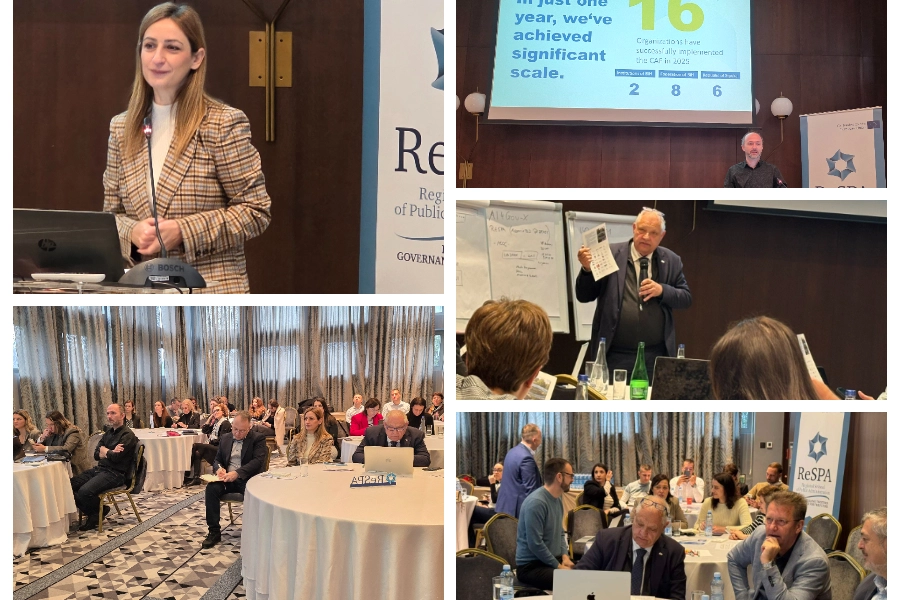
ReSPA’s 5th Annual RQMC Meeting strengthens Quality Management across the Western Balkans
Belgrade, 16–17 December 2025
ReSPA’s Regional Quality Management Centre (RQMC) held its 5th Annual Meeting in Belgrade, gathering a network of quality management practitioners, CAF Network members, EFACs, experts, and public administration institutions from across the Western Balkans. The meeting marked a significant step forward in consolidating a regional approach to quality management and fostering the long-term cooperation necessary for sustainable public administration reform.
Since its establishment in 2021, the RQMC has served as the region’s key platform for exchanging expertise, supporting QM systems, and promoting continuous improvement, and the 2025 meeting further reinforced this mandate.
At the opening, Director Handjiska-Trendafilova underlined the continuous development of the RQMC, the steadily growing number of institutions implementing the CAF and awarded the CAF Label, as well as the advancement of innovative quality-management practices: “Looking ahead to 2026, ReSPA is excited to roll out new initiatives focused on innovative learning methods, user-friendly tools, and targeted support-empowering public administrations and driving sustainable quality-management practices across the region.”
The meeting continued with a comprehensive review of QM developments across the region. National representatives shared progress, challenges, and priorities for strengthening quality systems within their public administrations: Elda Baguca, Albanian School of Public Administration; Kenan Avdagic, PARCO and Dalibor Ćopić, Civil Service Agencies of Republika Srpska, Zorana Popovic, Ministry of Public Administration of Montenegro; Emilija Georgieva Gjoshevski, Ministry of Public Administration of North Macedonia and Marija Petrovic, Ministry of State Administration and Local Self-Government of Serbia. Their interventions highlighted a growing commitment to institutionalising QM tools, including CAF, ISO methodologies, internal audit links and demonstrating that Western Balkan administrations are increasingly shifting from isolated QM initiatives to structured, sustainable systems.
The meeting included several speakers and experts who led technical sessions designed to deepen the region’s collective understanding of QM instruments and their synergies: Dragan Pušara, Director of the Accreditation Body of Serbia, illustrated how accreditation supports reliability, consistency and trust—key factors for public sector quality standards. Barbara Metcalf from the Municipality of Anderlecht showcased inspirational practices, emphasising the integration of the CAF into internal auditing and other management elements, while focusing on how these practices enhanced governance, change management, trust, and operational effectiveness within organisations and reflected on its multiple roles. Rade Dragović and Bojan Perović, in their presentation, focused on the ISO model, emphasising its current state and the most frequently utilised ISO standards in the public sector, discussing their significance and impact on organisational performance and governance, while highlighting synergies with financial control and coordination, and concluding by drawing parallels between CAF and ISO standards in relation to internal audit processes. Joyce Teunissen and Thomas Kerscher highlighted findings from inspiring cases on internal control and CAF, focusing on similarities and differences, lessons learned, potential scenarios and innovative approaches to deepen understanding of their interplay.
Finally, ReSPA, as an associated partner of the AI4GOV-X initiative, was delighted to host Peter Volk, who presented the initiative’s key findings on quality management. Peter Volk and Goran Paštrović are partners in the AI4GOV-X initiative, jointly contributing to its innovative, forward-looking work.
In summary, the first day of the meeting provided a comprehensive overview of quality management instruments and their interrelations, showcasing expert insights that collectively advanced the understanding of public sector quality standards and their implementation.
In addition, recognising the growing importance of skills beyond technical QM tools, the meeting dedicated its second day to agile management, communication and human-centred design, reflecting CAF 2020’s emphasis on leadership competencies, innovation and digital transformation.
Marija Mijatović presented the Effective and Assertive Communication in Change Management, while Sandra Nešić & Goran Paštrović shed light on Human-Centred Design & Agile Management.
Participants examined how people-centred methods, adaptive approaches, and clear communication enable institutions to navigate uncertainty, drive reforms and maintain service excellence.
The meeting concluded with a co-creation of the future of QM in the region, engaging participants through the World Café format. Facilitated by Sandra Nešić, Goran Paštrović and Marija Mijatović, the session enabled participants to collaboratively generate ideas and recommendations for the RQMC’s future strategic direction, new priorities, and the continued evolution of QM systems across the region.
A strong message running throughout the event was the critical importance of maintaining continuity of RQMC meetings. These gatherings sustain peer learning across administrations at all levels, strengthen regional alignment with EU public sector standards, support institutional capacity-building, forge lasting professional networks and finally, safeguard reform momentum beyond political cycles
The RQMC remains a cornerstone mechanism for driving long-term, region-wide progress in public administration quality management.
ReSPA and its network of experts and partners reaffirmed their commitment to advancing QM maturity across Western Balkan administrations and further integrating quality tools into strategic public administration reform. The collaborative spirit and forward-looking ideas shared during the 5th Annual Meeting will continue to shape the region’s approach to quality, innovation, and citizen-focused governance.
