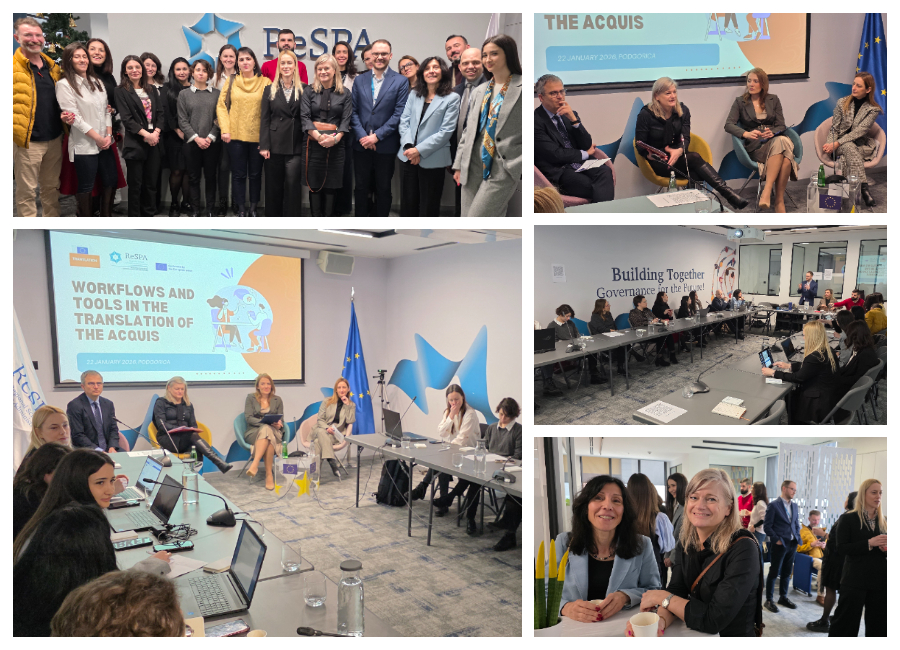


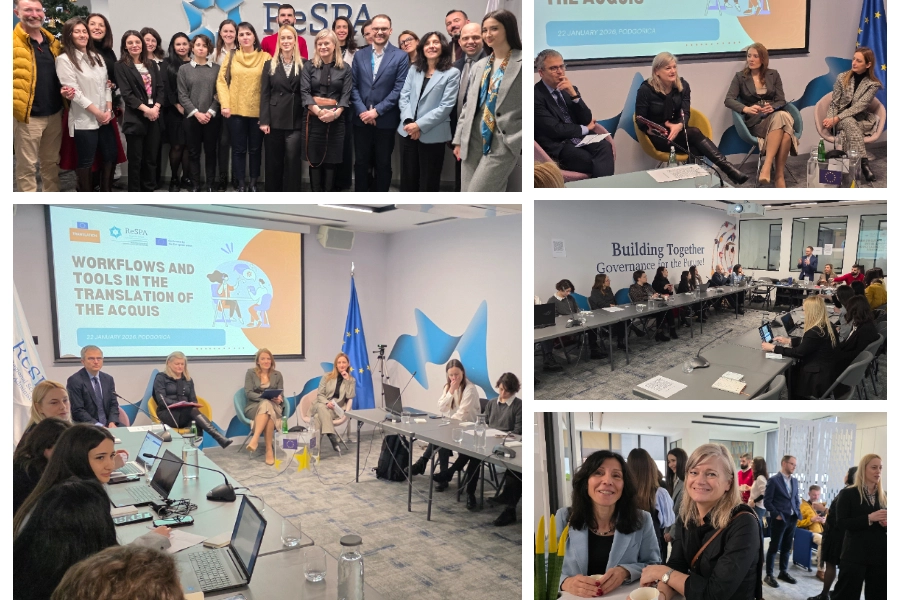
Strengthening acquis translation through peer learning: ReSPA and the European Commission bring Western Balkans administrations together
ReSPA Premises, Podgorica
Translation of the EU acquis is far more than a technical exercise - it is a cornerstone of EU accession, legal certainty, and effective governance.
Against this backdrop, the regional workshop “Workflows and Tools in the Translation of the Acquis”, organised by ReSPA in close partnership with the Directorate-General for Translation (DGT) of the European Commission, gathered representatives of Western Balkans administrations to explore modern, digital-first, and AI-supported approaches to acquis translation and publication.
Opening the workshop, Biljana Papović, State Secretary at the Ministry for European Affairs of Montenegro, underlined the importance of strong institutional coordination and close cooperation between national administrations and EU partners to ensure high-quality and timely translations that support accession negotiations and effective implementation on the ground. She also placed particular emphasis on the value of regional events of this kind, which are essential for civil servants across the Western Balkans to exchange experiences, share good practices, and discuss the challenges they face in translating the EU acquis.
Director Maja Handjiska-Trendafilova emphasised that without high-quality, consistent, and timely translations, there can be no legal certainty, no effective transposition, and no credible implementation of EU law. “Your work is not merely linguistic or administrative; it is fundamentally strategic for the European future of our administrations and societies. I sincerely thank our partners from the European Commission and the Publications Office for sharing not only their expertise, but also their time and trust in jointly shaping this important programme,” she concluded.
From the European Commission, Josefine Hederström, Head of the Coordination and Institutional Affairs Unit at the Directorate-General for Translation (DGT), highlighted the Commission’s strong focus on strengthening the capacities of Translation Coordination Units across the Western Balkans as a prerequisite for a smooth accession process. She noted that significant progress has been made in this field; however, staff remain the most valuable asset, alongside high-quality data. She also reaffirmed the Commission’s long-standing commitment to continue providing technical support to candidate countries, particularly through innovation, interoperability, responsible use of AI and sharing of good practices.
Bernard Brunet, Head of Cooperation at the EU Delegation to Montenegro, underlined that the translation of the EU acquis is not a procedural formality, but a strategic accelerator of European integration. “You cannot negotiate, transpose, or implement what is not fully understood in your own legal and administrative language. High-quality and timely translation of the acquis is what turns the accession process from a political commitment into a concrete, operational reform agenda,” he said.
The workshop provided a rich platform for peer exchange and expert insight. A Tour de Table session allowed Western Balkans administrations to present the current state of play in acquis translation, sharing progress, challenges, and priorities, and setting a solid foundation for joint learning.
Participants then benefited from in-depth expert sessions delivered by senior practitioners from EU institutions:
- Zoran Zakić, IT Portfolio Officer, and Miha Zličar, Language Technology Coordinator (DGT), presented best practices on CAT environments and AI-supported translation workflows;
- Thibault Charlet, Programme Manager at DG ENEST, introduced the eAccession tool, showcasing how AI can support legal alignment;
- Ivo Mihajlović, Team Leader at the Publications Office of the EU, explained the full production and publication process from manuscripts to EUR-Lex;
- Martin Scherbaum, Knowledge Management Officer (OP), unpacked the technical chain behind publishing legal acts on EUR-Lex;
- Nathalie Foigne and Lucia Skodlar, Coordinators of the Interinstitutional Style Guide, highlighted its role in ensuring consistency and clarity in multilingual EU legal documents;
- Maria Rzewuska-Waligora and Annamaria Fotos (DGT) demonstrated digital-first, human-led and AI-powered terminology workflows.
The day concluded with a forward-looking discussion on next steps and further cooperation in 2026, moderated by ReSPA Programme Coordinator Genti Xhaxhiu, who reaffirmed the importance of trust-based and strategic partnerships with the European Commission and DG Translation. He stressed that progress in this demanding field is only possible through close cooperation and mutual trust: “Effective translation of the EU acquis requires much more than technical expertise - it requires collaboration, shared standards, and continuous learning. ReSPA is proud to work hand in hand with the European Commission and national ministries to ensure that Western Balkans administrations are equipped with the modern tools, knowledge, and networks needed for a credible and sustainable EU integration process.”
By bringing together EU institutions, national ministries, and regional administrations, the workshop once again demonstrated the importance of strong partnerships between ReSPA, the European Commission, and national authorities for building resilient, professional, and future-ready public administrations across the Western Balkans.