

ReSPA Brought Beyond Classroom Learning to EGPA 2026 in Rome
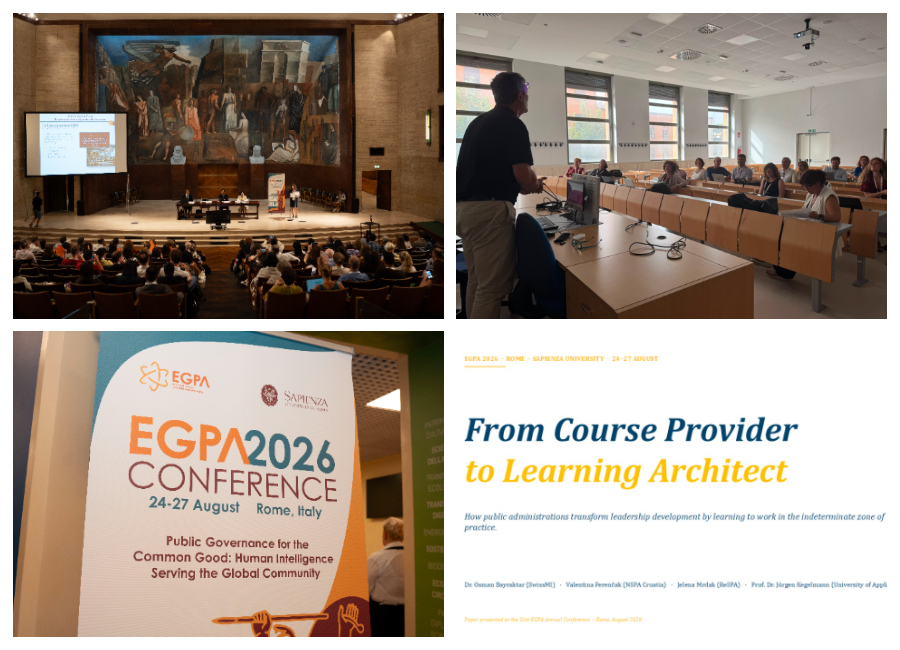
ReSPA Director a.i. Jelena Mrdak participated in the EGPA 2026 Conference, held from 24 to 27 August 2026 at Sapienza University of Rome, bringing ReSPA’s regional experience in leadership development and public administration learning to one of Europe’s foremost forums connecting research and practice in public administration.
The conference brought together researchers, practitioners and public administration professionals from Europe and beyond to exchange knowledge on some of the most pressing challenges facing contemporary governance.
A key ReSPA contribution took place on 27 August, within the Permanent Study Group on Education and Training, during the session “Leadership, simulation and professional behaviour.” The paper “From Course Provider to Learning Architect: How public administrations transform leadership development by learning to work in the indeterminate zone of practice” was presented as part of the session.
The paper was co-authored by Dr. Osman Bayraktar, SwissMI; Valentina Ferenčak, National School for Public Administration of Croatia; Jelena Mrdak, ReSPA; and Prof. Dr. Jürgen Kegelmann, University of Applied Sciences for Public Administration Kehl.
Moving leadership development beyond the classroom
The paper built on the Beyond Classroom Learning (BCL) initiative jointly developed and piloted by ReSPA and the Croatian National School of Public Administration.
Its starting point was the recognition that public administration leaders increasingly operate in complex situations where formal rules and procedures do not provide a complete answer. Digitalisation, demographic changes, evolving citizens’ expectations and fiscal pressures have made such situations more frequent, requiring public servants to combine professional judgement, collaboration, adaptability and learning from real work.
The paper argued that traditional classroom training remains important but cannot address this territory on its own. It therefore presented Beyond Classroom Learning as a framework for workplace-anchored leadership development, bringing together approaches such as mentoring, on-the-job learning, peer coaching, cross-departmental exchange and innovation labs.
At its core, the approach introduced the Do-It-Yourself Cycle (DIY-C), structured around four phases — Recognition, Activation, Design & Test, and Learning & Scale. The cycle starts with a real organisational challenge, enables public servants to develop and test solutions in their own working environment, and turns the experience into institutional learning that can be shared and scaled.
The approach is supported by the concept of Management Innovation, encouraging institutions to recognise that valuable learning opportunities and solutions can be generated from within the organisation itself. Over time, this can contribute not only to individual leadership capability but also to a stronger and more coherent organisational leadership culture.
Encouraging early evidence
The paper drew on an early-stage pilot involving 28 training managers from seven countries through two workshops organised in Zagreb, followed by a director-level discussion involving 13 senior officials.
It also incorporated findings from a survey of 78 participants at the 2026 OECD Network of Schools of Government meeting in Bangkok. Almost nine in ten respondents indicated that their institution would consider piloting a Beyond Classroom Learning approach within the following 24 months.
The findings were presented as encouraging early evidence rather than proof of completed institutional transformation. They nevertheless pointed towards an important evolution in the role of public administration training institutions: from course providers to learning architects.
Such a role goes beyond designing and delivering training. It involves helping administrations identify whether a particular challenge requires training, changes in processes or structures, digital solutions, or broader organisational and cultural transformation.
Connecting Western Balkan experience with European practice
During the conference, ReSPA also engaged in discussions of the Permanent Study Group on Education and Training addressing AI, digital learning and emerging training needs, connecting ReSPA’s work on leadership and professional development with wider European developments in public sector learning.
Participation in EGPA 2026 provided ReSPA with an important opportunity to bring the experience of Western Balkan public administrations into the European professional and academic debate, exchange approaches with partner institutions, and further strengthen the connection between research, institutional practice and public-sector innovation.
The Beyond Classroom Learning initiative will continue to be developed and tested with partner institutions, contributing to ReSPA’s broader goal of supporting adaptive, capable and future-ready public administrations across the Western Balkans and beyond.