

Quality Management Gains New Momentum: Sarajevo Conference Brings Together Europe’s and Region’s Key CAF Actors
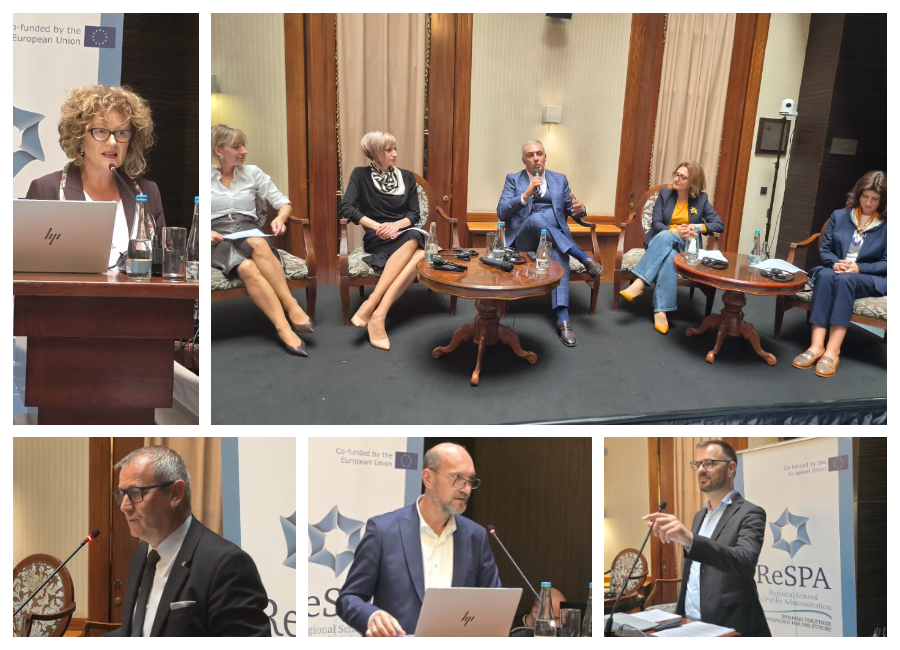
Quality management in public administration is moving from a specialised topic to an increasingly important part of how institutions improve performance, accountability and services to citizens. That growing momentum was strongly reflected in Sarajevo, where the Quality Management Conference: Strengthening Excellence and Performance in Public Administration in Bosnia and Herzegovina brought together public administration leaders, CAF practitioners and some of the most relevant European and regional actors working on quality management.
Organised by the Public Administration Reform Coordinator’s Office of Bosnia and Herzegovina (PARCO), the Civil Service Agency of the Federation of Bosnia and Herzegovina and the Civil Service Agency of Republika Srpska, with the support of ReSPA’s Regional Quality Management Centre (RQMC), the conference demonstrated how strongly the quality management community in the region has expanded and how increasingly connected it is with European expertise and institutions.
The conference was opened by Jelena Mrdak, ReSPA Director a.i.; Darko Kasap, Director of PARCO; Refik Begić, Director of the Civil Service Agency of the Federation of Bosnia and Herzegovina; and Dalibor Ćopić, from the Civil Service Agency of Republika Srpska, setting the tone for a day focused on strengthening quality management as a practical driver of better-performing public institutions.
“Excellence in public administration is not a final destination. It is a habit, a responsibility, and a commitment to keep asking ourselves: how can we serve people better?” underlined Mrdak.
“Quality management is becoming a practical driver of public administration reform in Bosnia and Herzegovina. The growing number of CAF users and recognised Effective CAF Users shows that institutions are moving beyond formal commitments towards a culture of continuous improvement — strengthening performance, building trust and delivering better services to citizens,” underlined Kasap, while Begić pointed out: “Quality in public administration is not measured by certificates or procedures, but by an institution’s ability to recognise its weaknesses, act on evidence and continuously improve. Our goal is for quality management in Bosnia and Herzegovina to become less a project and more a way of governing - ultimately delivering better institutions and better services for citizens.”
The gathering connected OECD/SIGMA, the European CAF Resource Centre at EIPA, KDZ Austria, UNDP Bosnia and Herzegovina, GIZ, national and local administrations from the Western Balkans, Moldova and Armenia, as well as CAF practitioners from across Bosnia and Herzegovina.
For ReSPA, this is also part of a much broader development. Over the past year, the Regional Quality Management Centre has been strengthening its role as a regional hub for CAF implementation, external feedback, peer learning and exchange with European partners, while expanding cooperation with administrations across both the Western Balkans and Eastern Neighbourhood.
The conference combined European experience with practical lessons from administrations in the region. Nick Thijs from OECD/SIGMA addressed the importance of quality management and CAF in the context of the Principles of Public Administration, while Tihana Puzić, Head of the European CAF Resource Centre at EIPA, presented CAF as a framework connecting public administrations across Europe and beyond.
A regional panel then brought together experiences from Serbia, Moldova, Montenegro, North Macedonia and the Eastern Partnership, exploring what CAF implementation looks like in practice and what administrations can learn from one another.
European local-government experience was added through contributions from KDZ Austria and the City of Starnberg in Germany, while the partnership with UNDP Bosnia and Herzegovina highlighted the implementation of CAF in local self-governments through the MEG3 project.
For Slaven Bukarica, ReSPA Quality Management Officer, the breadth of the conference reflects years of patient work behind the scenes: “What we see today did not happen overnight. It is the result of continuous work with colleagues in administrations, CAF practitioners and our European and regional partners - institution by institution, team by team. Our ambition with the RQMC has been to create much more than a support mechanism for individual CAF processes. We are building a regional quality management community that connects people, knowledge and institutions. The fact that EIPA, SIGMA, KDZ, UNDP, GIZ and administrations from across the region are contributing to the same conversation shows how far this community has come — and how much further it can go.”
The conference placed particular emphasis on the practical value of CAF and on experiences from institutions that have already gone through the process.
Representatives of local governments in Bosnia and Herzegovina shared examples of good practice and lessons from implementation, demonstrating how quality management can help institutions better understand their own strengths and weaknesses, improve internal processes and focus more clearly on results and service delivery.
The day concluded with the CAF Label Award Ceremony, recognising the City of Bosanska Krupa, City of Gradiška, Municipality of Srbac and the Legislative Office of the Council of Ministers of Bosnia and Herzegovina. Their recognition provided a fitting conclusion to a conference centred on one clear message: quality management is gaining ground because it produces practical change - and because institutions increasingly see value in learning, measuring, improving and sharing what works.
With a stronger RQMC, deeper cooperation with European institutions and expanding partnerships with actors such as UNDP and GIZ, ReSPA will continue supporting this momentum - helping quality management move from individual success stories towards a stronger regional standard for better-performing public administrations.