

From Visibility to Building Trust: ReSPA Launches a Regional Community for Government Communicators
18–19 June 2026, Budva, Montenegro
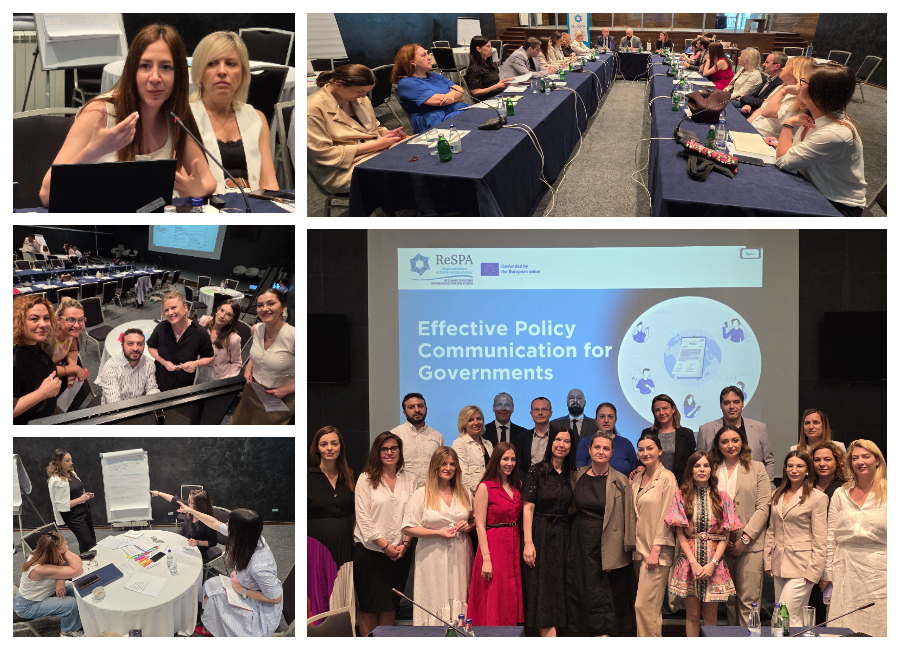
Government communication professionals, public officials and policy experts from the Western Balkans, Ukraine and Armenia gathered in Budva for ReSPA’s regional event “Effective Policy Communication for Governments”, marking the beginning of a more connected and practical regional community dedicated to stronger governmental policy communication.
The two-day event moved beyond the traditional workshop format. It created space for communication professionals to compare institutional realities, openly discuss shared challenges and begin shaping a living Community of Practice around ReSPA.
At the centre of the discussions was a clear message: government communication should not be limited to visibility, announcements and media coverage. It should be recognised as a strategic function of government and embedded throughout the policy cycle - from policy design and consultation to implementation and evaluation.
Only when communicators are involved early can they help turn complex reforms into messages that citizens can understand, use and trust.
The event was opened by Boris Ristović, Programme Coordinator at ReSPA, who welcomed participants and introduced a programme combining expert input, institutional experience and practical group work.
The event was strongly informed by the findings of the SIGMA/OECD study on governmental communication in the Western Balkans, Moldova and Ukraine. Martins Krievins, Senior Policy Advisor at SIGMA/OECD, presented key findings on institutional arrangements, regulatory frameworks, good practices and common challenges across the region. His sessions also explored how stronger communication can support more effective policymaking, implementation and public trust.
A central part of the event was dedicated to presentations from ReSPA beneficiaries and partner administrations, offering an honest picture of how governmental communication is currently organised and implemented.
Iva Kapoli, from the Media and Information Agency of Albania, presented Albania’s communication framework and institutional approach; Mubera Begić, from the Public Administration Reform Coordinator’s Office of Bosnia and Herzegovina, spoke about PAR communication across a complex multi-level governance system and the importance of stronger horizontal and vertical coordination; Snežana Žiga Lekić, from the Ministry of Defence of Montenegro, shared Montenegro’s communication practices and institutional experience; Olgica Radevska, from the Ministry of Public Administration of North Macedonia, presented the country’s current communication arrangements, priorities and challenges; Ana Jablanović, from the Ministry of Public Administration and Local Self-Government of Serbia, shared Serbia’s experience in communicating public administration reform and coordinating messages across institutions; Oleg Melnyk, from the Secretariat of the Cabinet of Ministers of Ukraine, provided insights into Ukraine’s communication practice in a particularly demanding institutional and information environment, while Ani Babayan, Adviser to the Deputy Prime Minister of the Republic of Armenia provided extensive overview of Armenian's online tools and advanced communictiaon with citizens. The sessions, moderated by Milena Drača, Communication and Visibility Manager at ReSPA, encouraged participants not only to present their national systems but also to respond to one another, identify shared patterns, and discuss practical solutions.
Across the presentations, several common issues emerged: communicators are often involved too late, communication is not always recognised as a strategic function, internal coordination remains weak, policy language is too technical, and institutions frequently measure visibility rather than understanding, participation, service uptake or trust.
The second day offered an important perspective from an EU Member State through a session led by experts from France’s General Secretariat for European Affairs. Joseph Giustiani, Pauline Martin and Floriane Chaigneau presented how policy coordination and communication on EU affairs are organised in practice in France. Their contribution offered valuable lessons on institutional coordination, the role of central government structures and the need to align communication with policy priorities.
The programme also included two practical exercises facilitated by Milena Drača. In the first exercise, participants worked on embedding communication throughout the policy cycle. Using the example of a new digital public service, they identified what communication should do at each stage - listen, explain, engage, prove and evaluate - and what people, skills, tools and coordination mechanisms are needed. The second exercise focused on the question: “What blocks us - and what should we do differently?”
Participants mapped shared institutional barriers, proposed practical improvements and drafted guidelines for stronger governmental policy communication. The gathering served as the kick-off of a regional Community of Practice for public communication professionals. The community is envisaged as a living, informal network where government communicators and policy officials can connect, exchange experience, test ideas, and jointly develop practical tools.
“The SIGMA study gave us the evidence and momentum to move from discussion to action. I am very happy to see such an open and valuable exchange among communication professionals from across the region. This meeting clearly shows that administrations are ready to build more effective policy communication with ReSPA’s support. Communication should have a strategic role in government, not only a tactical one. It must be involved throughout the policy cycle so that communicators can help make reforms understandable, useful and trustworthy for our citizens,” said Milena Drača, Communication and Visibility Manager at ReSPA.